Common TDEE Tracking Mistakes (and How to Fix Them)
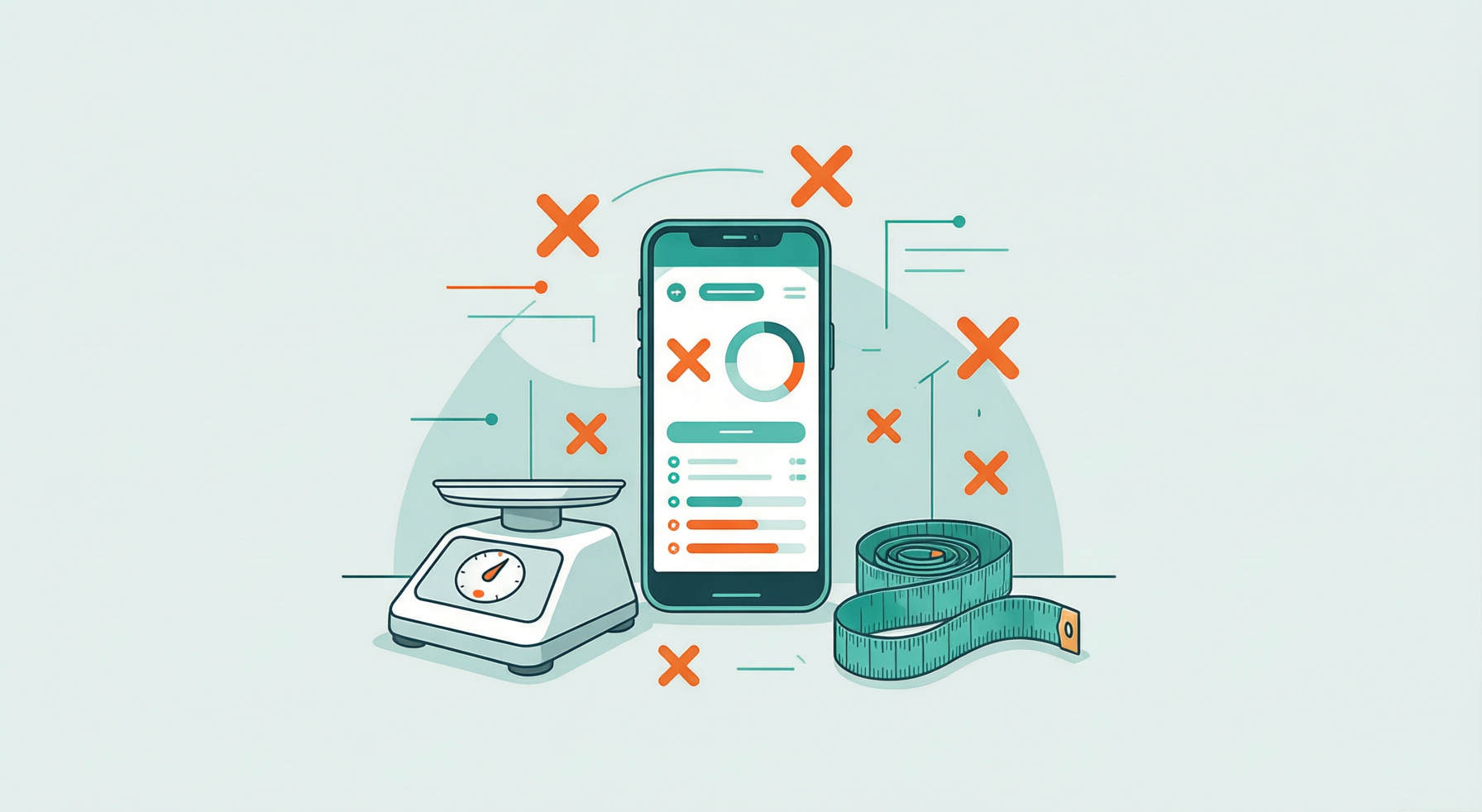
You calculated your TDEE, set a deficit, and started tracking your food. But after two weeks, the scale has not moved. Or worse, it has gone up. Before you conclude that your metabolism is broken or that calculators are useless, consider this: the most common reason TDEE-based diet plans fail is not a bad formula but bad execution.
This article covers the seven most common mistakes people make when tracking calories against their TDEE, explains why each one sabotages results, and provides specific fixes you can implement today.
Mistake #1: Overestimating Your Activity Level
This is the single most impactful error. TDEE calculators use activity multipliers (PAL values) ranging from 1.2 (sedentary) to 1.9 (extra active). The difference between "lightly active" (1.375) and "moderately active" (1.55) for a person with a BMR of 1,700 kcal is 298 calories per day. Over a week, that is 2,083 calories, or roughly 0.6 lbs of fat.
Most people overestimate their activity level because they focus on their workout and ignore the other 23 hours of the day. Here is the reality check:
| What You Think Counts As... | What Actually Counts |
|---|---|
| "Moderately active" (3-5 days/week exercise) | A physically demanding job (construction, nursing) OR structured exercise 4-5 days/week for 45-60 minutes at moderate-to-vigorous intensity |
| "Lightly active" (1-3 days/week exercise) | Office job with exercise 1-3 times per week, or a job that requires standing/walking most of the day without heavy lifting |
| "Sedentary" (little or no exercise) | Desk job with no structured exercise, or minimal movement throughout the day |
The fix: When in doubt, choose the lower activity level. It is much easier to add 100-200 calories to your intake than to figure out why your deficit is not producing results. See our activity level guidelines for a detailed breakdown of what each level actually looks like in practice.
Mistake #2: Not Accounting for Weekend Overeating
Research published in the Journal of the Academy of Nutrition and Dietetics found that weekend caloric intake averages 150-400 calories higher per day than weekday intake for most adults. For someone eating at a 500-calorie deficit Monday through Friday (total weekly deficit: 3,500 calories = 1 lb of fat), weekend overeating of just 300 extra calories per day (Saturday and Sunday) erases 600 calories, reducing the net weekly deficit to 2,900 calories. That is a 17% reduction in expected fat loss.
Many people who track meticulously during the week abandon tracking on weekends. Social events, restaurants, alcohol, and relaxed routines all contribute to higher intake that goes unrecorded. The result: a weekly average that does not match the deficit you intended.
The fix: Track food on weekends with the same rigor as weekdays. If you know you will eat at a restaurant, plan for it by eating slightly less at other meals that day. Alternatively, use a flexible dieting approach where you set a weekly calorie average rather than a daily target. If your weekly average intake matches your weekly average TDEE minus your target deficit, you are on track regardless of daily fluctuations.
Mistake #3: Ignoring the Thermic Effect of Food (TEF)
The thermic effect of food (TEF) is the energy required to digest, absorb, and store the food you eat. It accounts for approximately 8-15% of total daily energy expenditure. While TEF is relatively stable for a given diet composition, changes in macronutrient ratios can shift it meaningfully.
Here is how TEF varies by macronutrient:
| Macronutrient | Thermic Effect | Net Calories per 100 kcal Consumed |
|---|---|---|
| Protein | 20-30% | 70-80 kcal |
| Carbohydrates | 5-10% | 90-95 kcal |
| Fat | 0-3% | 97-100 kcal |
If you switch from a standard mixed diet (15% protein) to a high-protein diet (30% protein) during a cut, you increase your TEF by approximately 50-100 calories per day. Over a month, that is 1,500-3,000 additional calories burned, or roughly 0.4-0.9 lbs of extra fat loss. This is not huge, but it is free and requires no additional effort beyond choosing protein-rich foods.
The fix: During a cut, prioritize protein intake (0.8-1.0 g/lb of body weight) not only for muscle preservation but also for the slight metabolic advantage of higher TEF. Use our Macros Calculator to set appropriate macronutrient targets.
Mistake #4: Treating TDEE as a Static Number
Your TDEE is not fixed. It changes when:
- Your body weight changes. A 10-lb weight loss reduces TDEE by approximately 50-100 kcal/day because there is less body mass to maintain.
- Your body composition changes. Gaining muscle increases BMR; losing muscle decreases it.
- Your activity level changes. A new training program, a more active job, or a period of injury all shift TDEE.
- You experience metabolic adaptation. Prolonged caloric restriction causes the body to downregulate energy expenditure beyond what body composition changes alone would predict. See our metabolic adaptation article for details.
The fix: Recalculate your TDEE every 10-15 lbs of body weight change. If you have been dieting for 8+ weeks and your weight loss has stalled despite consistent tracking, your TDEE has likely decreased. Recalculate, and consider whether metabolic adaptation is playing a role.
Mistake #5: Confusing MyFitnessPal's Exercise Calorie Additions
MyFitnessPal (and similar apps) automatically add "exercise calories" to your daily budget based on data from connected fitness trackers or manually logged workouts. This creates a common and confusing error:
The problem: If you calculated your TDEE using an activity multiplier of 1.55 (moderately active), your daily calorie target already includes the calories burned from exercise. When MyFitnessPal adds exercise calories on top of that, you are being told you can eat more than your actual TDEE because the app is double-counting your activity.
The Double-Counting Trap
If your TDEE calculator says 2,500 kcal and MyFitnessPal adds 400 exercise calories, the app is telling you to eat 2,900 kcal. But your actual TDEE is already 2,500 (assuming you chose the right activity level). Eating 2,900 puts you in a 400-calorie surplus, not at maintenance. Over a month, that could result in 3-4 lbs of unintended fat gain.
The fix: You have two options:
- Option A (recommended): Set your activity level in MyFitnessPal to "sedentary" (1.2) and let the app add exercise calories from your tracker. This way, exercise calories are only counted once.
- Option B: Use your TDEE calculator's target (based on your actual activity level) and ignore the exercise calories that MyFitnessPal adds. Do not eat back those extra calories.
Do not do both. Choose one system and stick with it consistently.
Mistake #6: Portion Estimation Errors
Research consistently shows that people are terrible at estimating portion sizes. A study by Livingstone and Black (2004) found that individuals underreport caloric intake by an average of 10-45%, with higher underreporting among people with overweight and obesity. Common estimation errors include:
- Cooking oil: A "splash" of olive oil can be 1-3 tablespoons (120-360 calories). Most people log 1 teaspoon (40 calories).
- Nuts and nut butters: A "handful" of almonds can easily be 2-3 servings (300-450 calories vs. the 170 calories in a labeled 1-oz serving).
- Rice and pasta: A "cup" of cooked rice as served at a restaurant is often 1.5-2 cups (300-450 calories vs. the 200 calories in an actual cup).
- Protein portions: A "palm-sized" piece of chicken varies enormously. Weighing it reveals that what you thought was 5 oz is often 7-8 oz.
- Beverages: Smoothies, coffees with cream, juice, and alcohol are frequently underreported or omitted entirely.
The fix: Buy a digital kitchen scale (accurate to 1 gram, costs $10-15) and weigh everything for at least the first 4-6 weeks of tracking. This builds accurate visual calibration so that eventually you can estimate portions with reasonable accuracy. Until then, trust the scale, not your eyes.
Mistake #7: Not Adjusting for Weight Changes
As you lose or gain weight, your TDEE changes. A person who starts at 250 lbs with a TDEE of 3,000 kcal and drops to 220 lbs will have a new TDEE of approximately 2,750-2,850 kcal (depending on composition of weight lost). If they continue eating at their original 2,500 kcal target (a 500-calorie deficit from 3,000), their deficit is now only 250-350 calories because their TDEE has decreased.
This is why weight loss slows over time even with perfect adherence. It is not your metabolism "breaking"; it is simple math. Your energy needs decrease as your body gets smaller.
The fix: Recalculate your TDEE every 10-15 lbs of body weight change. Use our TDEE Calculator with your updated weight. If your deficit has shrunk and weight loss has stalled, you have two options: reduce intake by another 100-200 kcal, increase activity, or accept a slower rate of loss at your current intake.
The Adaptive Component
Beyond simple body size changes, prolonged dieting can trigger metabolic adaptation, where your body reduces energy expenditure beyond what body composition changes alone would predict. This typically becomes meaningful after 8-12+ weeks of continuous dieting. If you have been in a deficit for this long and your results have stalled despite accurate tracking, metabolic adaptation may be a factor. Consider a diet break (1-2 weeks at maintenance) before resuming your deficit.
Putting It All Together: The Accurate Tracking Protocol
- Calculate your TDEE using our TDEE Calculator. Choose the lower activity level if you are unsure.
- Set your target based on your goal (cutting: TDEE - 300-500; maintenance: TDEE; bulking: TDEE + 200-350).
- Buy a kitchen scale and weigh all food for at least 4-6 weeks.
- Track every day, including weekends. Use weekly averages, not daily numbers, to assess progress.
- Do not eat back exercise calories from fitness apps if your TDEE already includes exercise.
- Weigh yourself daily and calculate weekly averages to smooth out water fluctuations.
- Recalculate TDEE every 10-15 lbs of body weight change.
- If results stall after 2-3 weeks of consistent tracking, reduce intake by 100-200 kcal or increase activity. Do not assume the calculator is wrong before auditing your tracking accuracy.
Related Resources
- TDEE Calculator — Get your starting numbers
- How Accurate Is TDEE? — Understanding prediction equation limitations
- Activity Level Guidelines — Choosing the right multiplier
- Metabolic Adaptation — What happens during prolonged dieting
- How to Calculate TDEE Manually — Understanding the math behind the numbers
Frequently Asked Questions
The most common reasons are: (1) overestimating your activity level, which inflates your TDEE estimate; (2) underreporting food intake, which research shows averages 10-45% of actual consumption; (3) not accounting for weekend overeating, which can erase weekday deficits; (4) treating your TDEE as static when it changes as you lose weight; and (5) water retention masking fat loss. Track your intake and weight for 2-3 full weeks, then compare your empirical TDEE to the calculator estimate.
Generally no. If you selected the correct activity level when calculating your TDEE, your calorie target already includes exercise. Eating back exercise calories leads to double-counting. Additionally, fitness trackers overestimate exercise calorie burn by 20-50%. Either set your MyFitnessPal activity level to sedentary (1.2) and add exercise calories manually, or use your TDEE-based target and ignore the app's exercise additions. Do not do both.
Recalculate your TDEE every 10-15 pounds of body weight change, as your caloric needs shift with body size. Also recalculate if your activity level changes significantly (new job, injury, change in training volume). During a cut, your TDEE decreases as you lose weight, so failing to recalculate will make your deficit progressively smaller and slow your rate of loss.
Consumer fitness trackers (Apple Watch, Fitbit, Garmin) have a mean error of approximately 15-30% for calorie expenditure during specific activities, according to a 2020 study in Medicine & Science in Sports & Exercise. They tend to overestimate calories burned, particularly during strength training and low-intensity activities. Use them for trend tracking rather than precise calorie counting, and do not add their exercise calorie estimates to your TDEE-based food intake target.